

Content repurposing is a cost-effective way to extend the life of your content, save time, and increase engagement across multiple platforms. Instead of creating new content from scratch, repurpose your existing materials into platform-specific formats like videos, infographics, or social media posts. This approach can reduce content creation costs by up to 80% and boost organic traffic by 2x.
Key Benefits of Content Repurposing:
- Save Money: Repurposing costs $50–$200 per piece compared to $500–$2,000 for new content.
- Save Time: Teams report a 60% reduction in content creation time.
- Increase Reach: Repurposed content generates up to 3–5x more engagement.
- Boost ROI: 94% of B2B marketers report higher ROI from repurposing.
How It Works:
- Start with a high-value "pillar" piece (e.g., webinar, guide).
- Break it into smaller assets (e.g., LinkedIn posts, Instagram Reels).
- Tailor content to fit each platform’s style and audience.
Tools to Simplify Repurposing:
- CoSchedule: Plan and schedule content.
- Canva: Create visuals with ease.
- Lumen5: Turn blogs into videos.
- Repurpose.io: Automate content distribution.
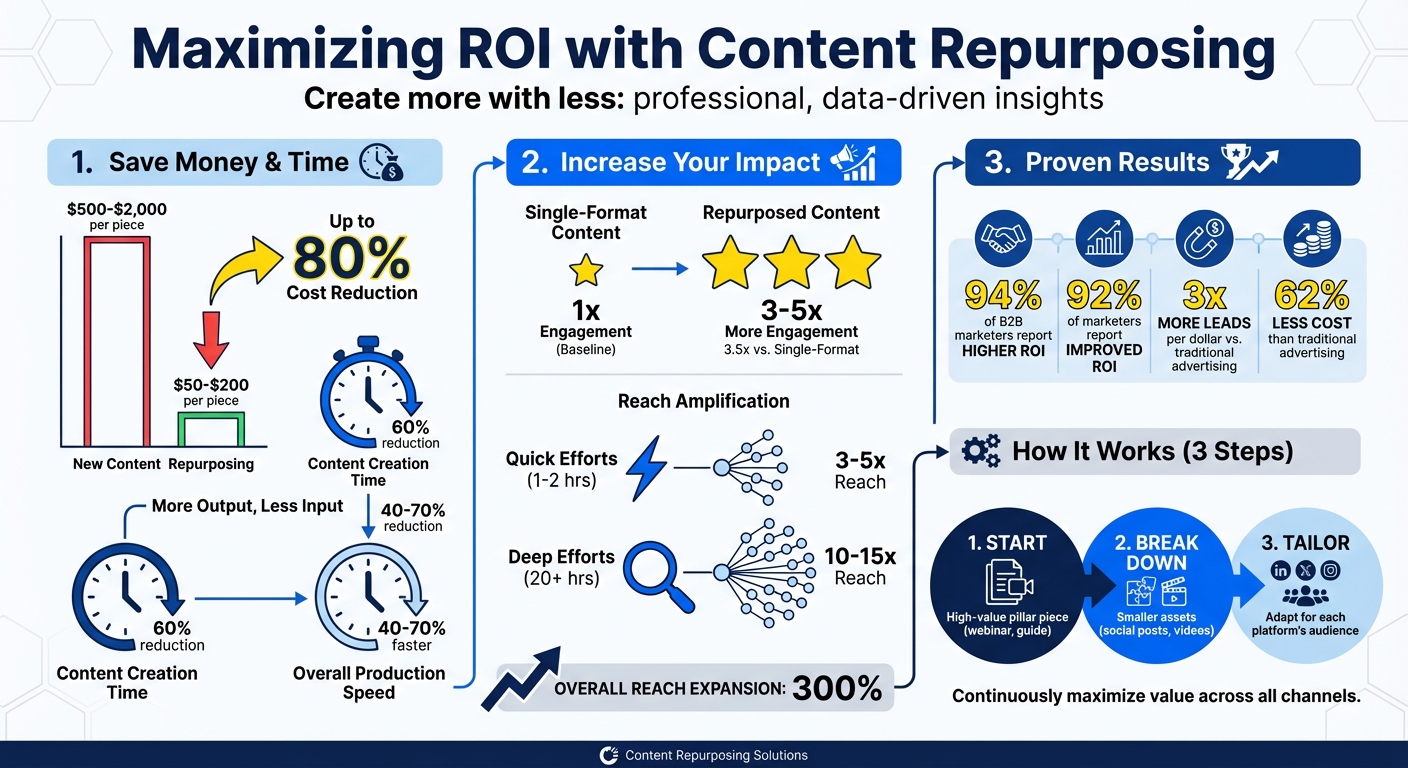
Content Repurposing ROI: Cost Savings and Engagement Statistics
The Content Repurposing System That Compounds Authority
sbb-itb-aebd855
Effective Content Repurposing Strategies
Repurposing content effectively means reshaping your core message to suit each platform’s style and audience while staying true to your brand voice. It’s not about duplicating content but tailoring it to fit specific channels. Here are three strategies to help you maximize your efforts and results.
Converting Long-Form Content into Micro-Content
Start with a substantial piece of content, and break it into smaller, stand-alone insights. Think of your main content as a collection of reusable "bricks": stats can become eye-catching graphics, quotes can be transformed into shareable social media cards, step-by-step instructions can turn into carousel posts, and key arguments can fuel your email campaigns [7].
Focus on creating "zero-click value" – content that delivers immediate insights without requiring users to click through [3]. For example, each H2 subheading in a blog post can serve as a LinkedIn update or newsletter snippet, a method some teams call the "Chop Shop" technique [3].
To maintain consistency, use templates for fonts, colors, and logos [6]. While AI tools can speed up content extraction and formatting by up to 70% [1], human oversight ensures your brand voice remains intact [5][3]. Companies that balance automation with a personal touch see 3.5× more engagement compared to those relying on single-format content [1].
| Micro-Content Format | Source Component | Strategic Goal |
|---|---|---|
| LinkedIn Carousel | Step-by-step guides or lists | Boost engagement and dwell time |
| X (Twitter) Thread | Bold opinions or listicles | Spark discussions and increase reach |
| Infographic | Data-heavy sections | Enhance shareability and retention |
| Quote Cards | Key expert insights | Build authority and quick consumption |
| Email Drip Series | Individual H2 sections | Nurture leads with actionable value |
Adapting Content for Different Platforms
Each platform has its quirks, so adjust your content accordingly. Use a Pillar-Cluster Framework: create a central, in-depth asset (like a blog post or webinar) and spin off 10–15 smaller pieces from it [8][10]. Spread out the release of these assets over several weeks to maintain audience interest and avoid overwhelming them [2][9]. Strategic repurposing can boost content output by 40% without increasing production time [8].
For video clips, always use a vertical 9:16 format and add bold captions since many users watch without sound [10]. Start with attention-grabbing hooks like "Here’s what everyone gets wrong…" to pull viewers in during the first few seconds [8][10]. These small tweaks can make the difference between content that’s ignored and content that grabs attention.
In addition to platform-specific tweaks, focus on keeping evergreen content in rotation for long-term impact.
Using Evergreen Content for Continuous ROI
Evergreen content – like tutorials, case studies, and frameworks – delivers 3× more engagement over time compared to trend-based pieces [11]. Start by identifying high-performing content with strong organic traffic or conversions, then update it with fresh data and repurpose it multiple times a year [1][7].
Organize your content using a three-bucket system:
- "Repurpose Now" for successful, still-relevant pieces.
- "Update & Repurpose" for content with potential but outdated details.
- "Leave As Is" for low-performing or time-sensitive items [7].
Space out major format changes – like transforming a blog into a webinar – by several months to avoid overexposure [7]. Use unique UTM parameters on each repurposed piece to track performance and identify what’s driving traffic and conversions [7].
These strategies are the foundation for streamlining your workflow and measuring the success of your repurposed content.
Tools and Workflows for Content Repurposing
The right tools can transform content repurposing from a tedious task into an efficient process. Choosing the right ones can help you get more value out of your content by making production and distribution faster and more accurate. A great example is Evernest, a property management company, which adopted CoSchedule’s Content Calendar in 2025. Content Manager McKenna Keller shared:
"Since we’ve implemented CoSchedule, our company’s doubled in size. Without this tool, we’d be floundering. Instead we’re completing 75% more work with the same team" [14].
These tools not only save time but also help track performance effectively.
Content Management and Scheduling Tools
CoSchedule offers a Marketing Calendar with Kanban and Table views, making it easy to visualize timelines and assign tasks [14]. If your team prefers more flexibility, Notion is a great alternative. It allows you to store Standard Operating Procedures (SOPs), organize content sources, and track approved excerpts [15][16]. A structured weekly workflow can make a big difference – set aside specific days for planning, creating flagship content, designing visuals, and batch scheduling [16].
For distribution, Repurpose.io is a game-changer. It syncs content from platforms like YouTube or TikTok and distributes it to multiple destinations automatically. Digital Marketing Strategist Molly Mahoney says:
"Not only does it allow me to seamlessly turn one video into over 15 pieces of content, it will then publish the content automatically, saving me and my team hours every week" [12].
Plans start at $35/month for up to 3 accounts per network, scaling to $179/month for agencies [12]. To keep your social media calendar active, tools like CoSchedule ReQueue and Buffer automatically recycle evergreen content, ensuring your top-performing posts stay in circulation [15].
Editing and Design Platforms
When it comes to visuals, Canva is hard to beat. Its "Magic Switch" feature resizes designs instantly for different platforms, while "Bulk Create" generates multiple variations from a single template. Canva Pro costs $14.99/month and includes a Brand Kit to maintain consistent fonts, colors, and logos across all content [21].
For video editing, Descript and Kapwing simplify the process with transcript-based editing, letting you edit video by modifying text. If you want to turn blog posts into videos, Lumen5 makes it easy, with plans starting at $29/month for basic features and $199/month for advanced options [21]. For audio content, Wavve creates audiograms – short, engaging video clips from podcasts or audiobooks. Meanwhile, Jalp AI turns written research into polished podcast-style audio for just $12/month [20].
Automation and AI-Powered Solutions
Automation takes repurposing to the next level. AI tools can speed up workflows, with 92% of marketers reporting improved ROI through repurposing [18]. Tools like Lately break down long-form content – blogs, podcasts, or videos – into dozens of social-ready snippets [15]. Repurpuz AI goes a step further, converting video transcripts into drafts for blogs, newsletters, and LinkedIn posts [16].
Zapier connects your CMS, calendars, and social platforms, triggering posts automatically when new content is added [13]. Refreshing and redistributing content every 90 days can also boost AI citations by up to 4.8× compared to static content [17]. Alex Halliday, CEO of AirOps, explains:
"What you’re really doing is trying to make sure your content is prepared for citation, and you really want to become the answer that the models cite" [17].
To make repurposing even easier, build a library of templates for formats like Twitter threads, LinkedIn posts, and newsletters. This way, repurposing becomes as simple as filling in blanks [16]. By automating the publishing process, you can focus on strategy while the tools handle the day-to-day tasks [15].
With these tools and workflows in place, you’re ready to measure and refine the performance of your repurposed content.
Measuring the ROI of Repurposed Content
Tracking the return on investment (ROI) for repurposed content requires a tailored strategy. While 83% of marketing leaders prioritize demonstrating ROI, only 36% feel confident in accurately measuring it [24]. Repurposing content delivers results, but these often span multiple platforms and take time to materialize. To succeed, you need to focus on the right metrics and attribution models that align with your business objectives. These metrics naturally guide more detailed calculations and cost-benefit evaluations.
Key Performance Indicators (KPIs) for Repurposed Content
KPIs for repurposed content fall into three main categories: efficiency, performance, and business impact. Each provides a unique lens for understanding how repurposing contributes to your overall strategy.
- Efficiency metrics assess internal productivity, such as time and cost savings. For instance, repurposing two source pieces into 18 adaptations might cost $2,000, compared to $10,000 for creating 20 individual pieces from scratch. That’s a savings of $8,000 per month [1]. Similarly, repurposing can reduce content creation time by 40-70% [1].
- Performance metrics measure audience engagement, including reach, traffic, and interaction rates. Quick repurposing efforts (1-2 hours of work) can amplify reach by 3-5x, while deeper efforts (20+ hours) can achieve 10-15x amplification [1].
- Business impact metrics tie content efforts directly to revenue. Content marketing, for example, generates 3x more leads per dollar spent than traditional advertising and costs 62% less [5]. Evergreen content is particularly powerful – brands like HubSpot report that 76% of monthly blog views come from older posts, and optimizing these can boost organic traffic by up to 106% [22].
| Metric Category | Key Indicators | Purpose |
|---|---|---|
| Efficiency | Time savings, cost per piece | Tracks resource optimization |
| Performance | Reach, engagement, lead attribution | Measures audience response |
| Business Impact | Revenue attribution, CAC reduction | Links content to financial outcomes |
ROI Calculation Formulas and Attribution Models
To measure ROI accurately, you need a clear formula and attribution models that reflect how content contributes to your goals. The standard ROI formula is straightforward: (Value Generated – Cost of Content) / Cost of Content × 100. However, defining "value" requires nuance. Value can come from direct revenue, pipeline influence, organic traffic savings, and even AI citations [24].
Attribution models help distribute credit for repurposed content across the customer journey:
- First-Touch Attribution assigns 100% credit to the first interaction, ideal for gauging brand awareness.
- Multi-Touch Attribution spreads credit across all touchpoints, best for complex B2B sales cycles.
- Time-Decay Attribution gives more weight to recent interactions, useful for conversion-driven campaigns [24].
For example, when calculating pipeline influence, assign 20-40% credit to content to reflect its partial role in closing deals [24]. AI citations can also be quantified using this formula: (Citation Count × Avg Impressions Per Citation × $25 CPM / 1,000) [24]. Additionally, calculate cost avoidance by estimating savings from organic traffic. If a keyword costs $5 per click in Google Ads and generates 1,000 organic clicks monthly, that’s $5,000 in saved ad spend [24].
Content ROI tends to grow over time. A program might achieve a 367% ROI in its first year, increasing to 656% by year three as assets mature [24]. As Zach Chmael, CMO at Averi, notes:
"Content ROI is genuinely hard to measure – not because content doesn’t work, but because the ways it works are distributed, delayed, and increasingly invisible to traditional analytics" [23].
To avoid undervaluing your efforts, measure ROI over 6-month and 12-month periods instead of monthly [24].
| Model | Credit Distribution | Best Use Case |
|---|---|---|
| First-Touch | 100% to the first interaction | Awareness and top-of-funnel discovery |
| Multi-Touch | Distributed across multiple points | Complex B2B sales cycles |
| Time-Decay | More credit to recent interactions | Conversion-focused campaigns |
Conducting a Cost-Benefit Analysis
A cost-benefit analysis helps refine your repurposing strategy by weighing costs against potential revenue and growth. Start by defining clear goals – such as reach or lead generation – and assigning monetary values to both costs and benefits [25]. This creates a common framework for evaluating different strategies.
Consider these cost categories:
- Direct costs: Expenses tied to repurposing workflows.
- Indirect costs: Hidden expenses like software or training.
- Intangible costs: Hard-to-quantify factors like team morale.
- Opportunity costs: Missed chances to invest in other projects.
On the benefits side, include:
- Direct benefits: Revenue and sales from repurposed content.
- Indirect benefits: Increased visibility and engagement.
- Intangible benefits: Enhanced brand authority or team satisfaction [25].
For example, using Google Search Console, you might prioritize repurposing "Page 2" content – posts ranked 11-20 or those with high impressions but low click-through rates [1]. Evergreen formats like how-to guides are especially effective since they can be reused 4-5 times annually, compared to trending content with only a 2-4 week lifespan [1].
The 5-to-1 Rule is another useful tactic: aim to create five smaller assets (e.g., social posts) from every long-form piece. Repurposing a 2,000-word blog post into 10 social posts, an email sequence, and a video script might take 4-6 hours, compared to 8-12 hours for creating the original. That’s a 40% time investment for a potential 300% increase in reach [1].
Tim Stobierski, a business analyst, explains:
"A cost-benefit analysis is the process of comparing the projected or estimated costs and benefits (or opportunities) associated with a project decision to determine whether it makes sense from a business perspective" [25].
To stay on track, review tactical metrics weekly, funnel performance monthly, and financial ROI quarterly [24]. This rhythm ensures you’re making informed decisions without getting bogged down in data.
Optimizing Your Repurposing Strategy for Long-Term Growth
Measuring ROI is just the start. To maintain momentum, it’s essential to refine your repurposing strategy through regular testing, reviews, and scalable processes. Below, we’ll dive into practical methods like A/B testing and streamlined review workflows to help you sharpen your approach.
A/B Testing for Format and Platform Optimization
Testing is key to figuring out what works best. Experiment with different formats to see which ones resonate with your audience. For instance, try headline variations: a question-based hook might perform better for a LinkedIn post, while a bold statement could grab attention on X (formerly Twitter).
Visual formats are just as important to test. Compare carousels versus single images or try short-form video clips. Research from Wistia shows that short clips pulled from longer videos can generate 40% more views than standalone short videos [1]. You can also experiment with posting times to find when your audience is most active. To track results effectively, use unique UTM parameters for each asset. This data can help you zero in on what drives traffic and conversions, allowing you to focus on the formats and strategies that deliver the best results.
Establishing a Quarterly Review Process
A quarterly review ensures your repurposing efforts are aligned with your business goals. Start by analyzing performance metrics like ROI, reach, and conversions to identify the strategies driving growth [5][18]. Then, conduct a content audit to identify potential pillar content [7].
Organize your content into three categories during the review:
- Repurpose Now: High-performing evergreen content.
- Update & Repurpose: Content with potential but requiring updated stats or fresh information.
- Leave As Is: Low-performing or time-sensitive pieces.
This categorization helps you prioritize resources for the biggest impact.
| Review Category | Key Metrics to Evaluate | Strategic Goal |
|---|---|---|
| Efficiency | Time reduction, cost per piece, workflow efficiency | Reduce production costs and prevent team burnout [5] |
| Performance | Reach amplification, engagement rates, social shares | Maximize audience touchpoints and brand awareness [18] |
| Business Impact | Revenue attribution, lead generation, CAC reduction | Demonstrate and improve ROI of repurposing efforts [5][18] |
Evaluate workflow efficiency by identifying bottlenecks and comparing the time needed for original creation versus repurposing [5][18]. Also, track how different formats perform across platforms – like carousels versus short-form videos – to discover where your audience is most engaged [18]. A cross-platform presence can boost brand recall by 4.3x [18]. Use these findings to refine your strategy, update templates, and set new quarterly goals [5].
Once you identify performance gaps, you can scale successful tactics using repeatable processes.
Scaling Repurposing with Repeatable Processes
To scale effectively, you need systems that don’t require constant supervision. The Waterfall Method is a great way to break a core piece of content into smaller, reusable assets [3]. By dividing content into modular elements – like statistics, quotes, and key insights – you can extract maximum value from every piece [7].
The 3x3x3 Framework is another helpful tool. It ensures each original piece includes three key insights, three compelling stories, and three actionable takeaways, making it easier to repurpose content later [18]. This approach can cut content production time by 60% to 80% [18]. Companies that embrace repurposing strategies report 3.5x more engagement compared to those focusing on single-format content [1].
Efficient scaling also requires clear roles. Use a RACI Matrix to assign tasks:
- Content Strategist: Ensures quality.
- Content Creator: Provides context.
- Content Adapter: Handles execution.
- Performance Analyst: Updates and tracks results [5].
To keep things organized, implement strict naming conventions (e.g., BlogPost_Topic_Platform_Format_YYYY-MM-DD) and centralized storage for assets [5]. Maintain "Platform Bibles" – living documents that outline formatting rules, emoji usage, and audience preferences for each platform [18].
Batching can also save time. Dedicate one day a month to repurposing multiple high-performing blog posts [3]. Spread out the distribution of repurposed content over weeks or months to avoid overwhelming your audience and to extend the content’s lifespan [5][7]. As WordStream puts it:
"The content repurposing calculus is pretty simple: get the greatest reach from the fewest resources" [5].
Conclusion
Repurposing content allows you to reshape your core ideas into formats tailored for different platforms, all while maintaining your brand’s unique voice. This strategy can expand your content’s reach by an impressive 300% [19] and drive 3.5× more engagement compared to sticking with a single format [1].
Start by auditing your existing content to spot top-performing pieces and plan how to adapt them into various formats. Evergreen content, in particular, is a valuable asset – it saves both time and resources.
Here’s a simple way to think about it:
"The repurposing calculus is simple: get the greatest reach from the fewest resources." – WordStream [5]
While AI tools can help streamline the process, working with experts like ChrisRubinCreativ (CRC) ensures your repurposed content stays authentic and aligns with your broader strategy. Professionals can help you avoid creating unnecessary content [4] and ensure your repurposed materials fill gaps in the buyer journey while boosting long-term search traffic [26].
Start small – test the waters and build repeatable systems. With the right approach, you can get the most value out of every piece of content you produce, seamlessly weaving repurposed assets into your brand’s larger story.
FAQs
What content should I repurpose first?
Kick things off with a detailed blog post or an in-depth article. Why? Because these types of content are packed with information that can be reshaped into various formats. From videos and social media posts to infographics and email sequences, a single long-form piece can fuel multiple content channels.
This method not only broadens your reach but also boosts engagement across platforms – all without starting from scratch every time. To make the process even smoother, consider using automation tools. They can help you repurpose content efficiently, saving time while keeping your output consistent.
How often should I repost evergreen content?
Reposting evergreen content every 3 to 6 months is a smart way to extend its value and maintain its reach. Be sure to tailor the reposting frequency to align with your platform’s standards and how your audience interacts with your content for the best outcomes.
How do I track ROI across platforms?
To keep tabs on ROI across different platforms, leverage tools that help you track how your content performs and how audiences engage with it on each channel. Start by setting clear goals and measurable KPIs – think metrics like reach, engagement, and conversions. Pay attention to platform-specific stats, such as click-through rates and conversion rates, to get a more precise picture of what’s working. Regularly review and compare performance data to spot top-performing platforms and refine your content repurposing strategy accordingly.