
Sentiment analysis and brand perception analysis are two approaches businesses use to understand customer opinions. While sentiment analysis focuses on the emotional tone of real-time feedback (positive, negative, or neutral), brand perception analysis evaluates the long-term beliefs and associations tied to a brand. Here’s a quick breakdown:
- Sentiment Analysis: Tracks immediate reactions using AI and NLP tools, ideal for monitoring campaigns, managing crises, and identifying short-term trends.
- Brand Perception Analysis: Examines overall consumer opinions through surveys, focus groups, and brand audits, providing insights into reputation, loyalty, and market positioning.
Key Differences:
- Scope: Sentiment analysis is narrow (specific interactions), while brand perception is broad (overall reputation).
- Speed: Sentiment analysis delivers real-time insights; perception analysis takes longer but offers deeper understanding.
- Output: Sentiment analysis shows emotional trends; perception analysis uncovers brand equity and customer loyalty factors.
Quick Comparison:
| Feature | Sentiment Analysis | Brand Perception Analysis |
|---|---|---|
| Focus | Emotional tone of interactions | Long-term brand reputation |
| Methods | AI, NLP, machine learning | Surveys, focus groups, competitive analysis |
| Best For | Real-time monitoring, crisis response | Strategic planning, brand audits |
| Limitations | Struggles with sarcasm and context | Time-consuming and resource-intensive |
Takeaway: Use sentiment analysis for immediate insights and brand perception analysis for in-depth reputation evaluation. Together, these tools can improve customer understanding and drive better business decisions.
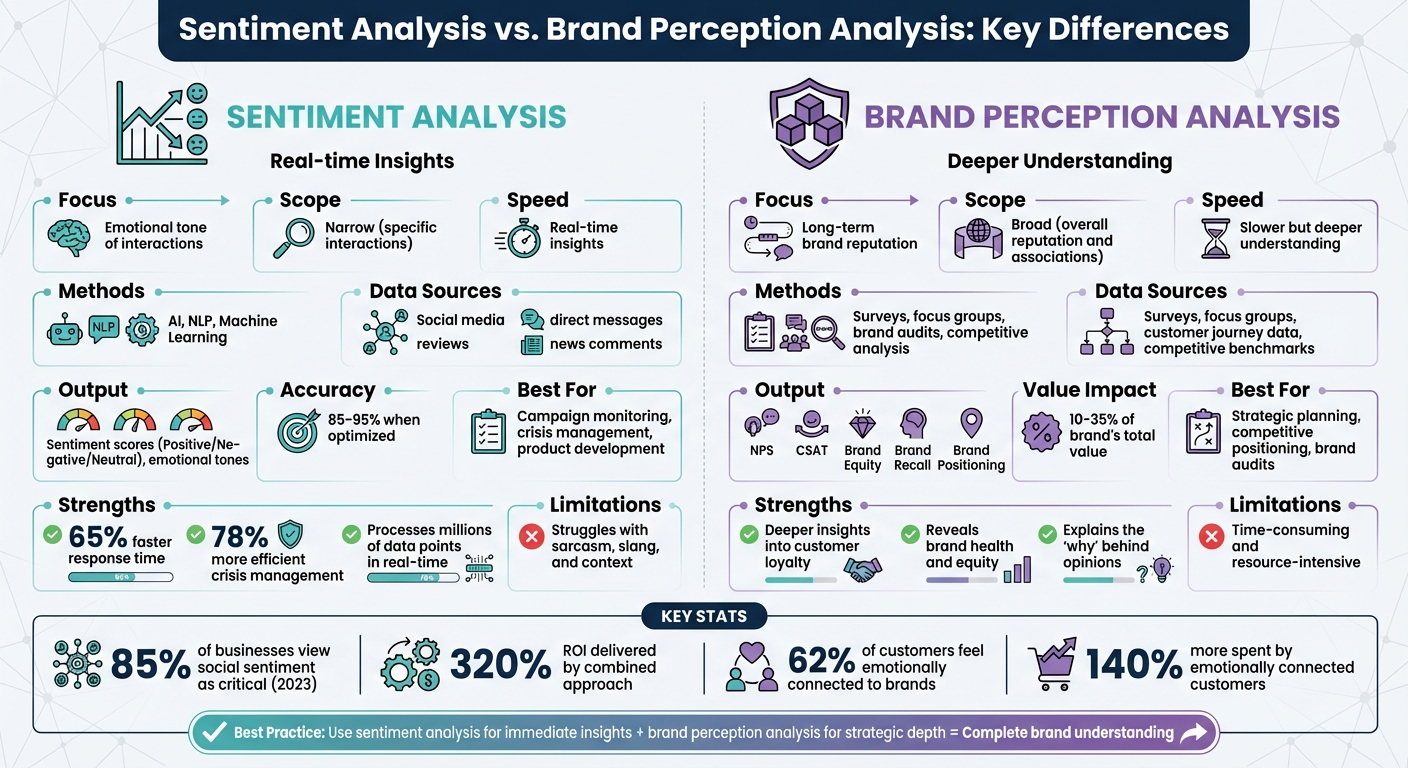
Sentiment Analysis vs Brand Perception Analysis: Key Differences Comparison
Main Differences Between Sentiment Analysis and Brand Perception Analysis
What is Sentiment Analysis?
Sentiment analysis uses natural language processing (NLP) and machine learning models like BERT and RoBERTa to classify text as positive, negative, or neutral [12]. It’s all about analyzing unstructured content to pick up on the emotional tone of specific mentions. This makes it a go-to tool for gauging immediate reactions to events or campaigns in real-time.
Take a December 2023 study, for example, which reviewed 15,765 tweets about five automobile brands using TweetNLP and a RoBERTa-base model. The study calculated a Brand Polarity Score (BPS), revealing that BMW attracted the highest number of positive tweets during the period. This highlights how sentiment analysis can map competitive brand positioning almost instantly [12].
The real strength of sentiment analysis lies in its speed and scale. It can handle millions of data points in near real-time, which is invaluable for crisis management and quick responses. Companies using advanced sentiment analysis have seen brand response times improve by 65% and crisis management become 78% more efficient [3]. However, it’s important to note that sentiment analysis captures the "what" of emotional reactions but doesn’t always explain the "why" behind them [11]. That’s where brand perception analysis comes in.
What is Brand Perception Analysis?
Brand perception analysis digs deeper, looking at how consumers emotionally, cognitively, and symbolically view a brand. It considers everything – from advertising and customer service to product experiences – providing a comprehensive picture of consumer sentiment and beliefs [5][7]. This approach blends qualitative and quantitative methods like focus groups, interviews, surveys, brand audits, and competitive analysis [5][8].
For instance, during the COVID-19 pandemic (March to June 2020), researchers in Indonesia examined 11,040 media posts and 8,852 tweets about 15 companies. One pharmaceutical company gained 45% positive sentiment for selling affordable masks but also faced 34% negative sentiment due to public distrust. To make sense of these mixed results, a two-hour focus group discussion with 12 participants on September 22, 2020, revealed that perceptions were influenced more by the company’s pre-pandemic behavior and communication strategy than by the donation itself [11].
Brand perception analysis answers a key question: What do people think your brand stands for? It assesses long-term reputation, brand equity, and whether your brand identity matches consumer expectations. This makes it a critical tool for strategic positioning and fostering customer loyalty [5][8]. Unlike sentiment analysis, it provides a more in-depth, strategic perspective.
Snapshot vs. Full Evaluation
While both methods serve different purposes, they complement one another. Sentiment analysis gives you a "snapshot" of immediate reactions – making it ideal for monitoring campaigns or spotting emerging issues [9]. On the other hand, brand perception analysis provides a "full evaluation", capturing the long-term beliefs and associations consumers have with your brand [10][7].
As Dynata puts it:
Sentiment is best viewed as a diagnostic or contextual KPI… its main value is in explaining why other brand KPIs, such as awareness, consideration, or loyalty, are changing [10].
This means shifts in sentiment often act as early indicators of changes in consumer behavior. Meanwhile, brand perception reflects the deeper mental connections that influence purchasing decisions and customer loyalty.
For example, in February 2024, Nike used social media sentiment analysis to track millions of interactions. They found that "quality" and "comfort" drove positive sentiment, while "pricing" and "limited edition availability" were pain points. By addressing these issues, Nike saw a 15% rise in positive sentiment, a 20% jump in social engagement, and a 10% boost in customer loyalty [4]. This shows how real-time sentiment insights can play a vital role in shaping broader brand perception strategies when used together.
sbb-itb-aebd855
Where Sentiment Analysis and Brand Perception Analysis Overlap
Common Data Sources
Both sentiment analysis and brand perception analysis rely on a variety of shared data sources. These include social media platforms like Twitter, Facebook, Instagram, LinkedIn, and Reddit, as well as review sites such as Amazon, Yelp, Trustpilot, G2, and Glassdoor. Additional sources include customer service transcripts, surveys, forums, blog posts, and news articles.
While both approaches use natural language processing (NLP) to analyze this data, the difference lies in the depth of analysis. Advanced Natural Language Understanding (NLU) techniques go a step further by identifying subtleties like sarcasm or context-specific meanings. For instance, NLU can determine whether the word "expensive" is meant as a critique or as an indicator of luxury.
These shared data sources and analytical tools create a foundation for connecting immediate consumer sentiments to longer-term brand perceptions.
Using Sentiment to Inform Perception
Immediate sentiment trends often act as early indicators of shifts in brand perception. As Marty Neumeier once said, "Your brand isn’t what you say it is. It’s what they say it is" [15]. Sentiment analysis allows brands to dig into the "why" behind consumer opinions – whether it’s praise for product quality or concerns over pricing – shedding light on the factors that shape how a brand is viewed.
Take the example of Chick-fil-A in May 2025. The company faced backlash after replacing its Original BBQ sauce. Fans expressed their dissatisfaction using the hashtag #BringBackTheBBQ. By leveraging Sprinklr‘s social listening tools, Chick-fil-A quickly identified the negative sentiment and responded to over 5,000 fan messages. This proactive approach turned the sentiment around, shifting it from 73% negative to 92% positive in just a few days [15].
Emotionally connected customers are about 52% more valuable than those who are simply satisfied [13]. Through aspect-based sentiment analysis, brands can isolate specific topics – like customer service versus product durability – and identify the emotional triggers that build trust and loyalty. By combining real-time sentiment data with broader insights into brand perception, companies can gain a fuller understanding of their reputation and how to sustain it over time.
Comparison Table: Sentiment Analysis vs. Brand Perception Analysis
Comparison Table
Here’s a quick look at how sentiment analysis and brand perception analysis differ. While both aim to understand customer opinions, their focus, methods, and results set them apart. The table below highlights these differences:
| Feature | Sentiment Analysis | Brand Perception Analysis |
|---|---|---|
| Scope | Narrow: Focuses on the emotional tone of individual interactions or mentions [4]. | Broad: Encompasses all associations, beliefs, and experiences tied to the brand [5][8]. |
| Primary Methodology | Automated: Relies on AI, NLP, and Machine Learning [3][4]. | Mixed: Combines surveys, focus groups, brand audits, and sentiment data [8][6]. |
| Data Sources | Social media, reviews, direct messages, news comments [3][2]. | Surveys, focus groups, customer journey data, and competitive benchmarks [5][8]. |
| Output | Sentiment scores (Positive/Negative/Neutral), emotional tones like joy or anger [6][4]. | Metrics like NPS, CSAT, Brand Equity, Brand Recall, and Brand Positioning [8][6]. |
| Strengths | Real-time insights, scalable, identifies potential crises quickly [3][4]. | Provides deeper insights into customer loyalty and overall brand health [8]. |
| Limitations | Struggles with sarcasm, slang, and regional nuances [4]. | Slower to gather data and often requires significant resources [8][6]. |
Modern sentiment analysis tools boast accuracy rates of 85% to 95% when optimized effectively [3]. This makes them a dependable choice for real-time monitoring. In fact, 85% of businesses now view social sentiment as a critical part of their brand monitoring efforts [3]. On the other hand, brand perception analysis plays a longer game, with consistent marketing efforts contributing 10% to 35% of a brand’s total value [2].
These differences highlight when each method shines. Sentiment analysis is ideal for capturing immediate reactions, while brand perception analysis uncovers the underlying factors driving customer loyalty and brand value. Up next, we’ll explore how these tools fit into broader brand strategies.
Use Cases in Brand Strategy
Applications of Sentiment Analysis
Sentiment analysis offers real-time insights into how customers feel about your brand. One of its most immediate uses is campaign monitoring. When rolling out a new product or marketing campaign, sentiment analysis tracks emotional reactions as they happen. This allows you to tweak your messaging on the fly, preventing campaigns from veering off course. Brands utilizing sentiment analysis have reported a 65% faster response time to customer feedback [3].
Another vital use is in crisis management. Automated tools for sentiment detection act like an early warning system, flagging negative trends before they spiral out of control. These tools have proven to be highly effective, increasing crisis management success rates by 78% when employed [3].
When it comes to product development, sentiment analysis helps make the process 52% more targeted [3]. By examining customer feedback, brands can pinpoint what customers love and what frustrates them. For instance, you might discover that while product quality receives praise, issues like pricing or availability trigger complaints. Addressing these specific concerns can lead to better customer loyalty and stronger engagement.
Customer support optimization is another area where sentiment analysis shines. By identifying recurring pain points, support teams can respond more empathetically and efficiently. This not only boosts trust but also enhances brand perception. In fact, customer satisfaction can increase by 45% when support strategies are guided by sentiment data [3]. And the financial impact? Satisfied customers are shown to spend up to 140% more [14].
While these immediate applications are critical for day-to-day operations, long-term brand strategy benefits greatly from deeper insights provided by brand perception analysis.
Applications of Brand Perception Analysis
Beyond real-time sentiment, brand perception analysis helps shape long-term strategies for growth. One of its primary uses is in competitive positioning. By understanding how your brand stacks up against competitors, you can identify opportunities to stand out. For example, Entel, a telecom company in Chile and Peru, used social listening to tap into an online campaign by BTS fans. This move increased their online conversation volume by 196% and shifted brand sentiment from negative to positive [7].
Another key application is in building brand equity. A strong perception allows brands to command premium prices and weather economic challenges. Take Patagonia, for example. When customers began labeling the brand "Patagucci" due to its high prices, Patagonia doubled down on its sustainability mission by launching the "Worn Wear" line of recycled clothing. This move realigned its image with its values, reinforcing its reputation for responsible manufacturing [5].
Aligning messaging with reality is another area where perception analysis proves essential. Research indicates that 60% of executives feel their companies aren’t communicating the right message to customers [5]. Yet, 62% of customers report feeling emotionally connected to the brands they buy from [5]. This gap underscores the importance of regular brand audits to ensure your messaging resonates with your audience and reflects your brand’s identity.
ChrisRubinCreativ (CRC) addresses this challenge with its Brand Foundation services. By helping brands align their internal goals with how consumers actually perceive them, CRC ensures consistency across messaging, visuals, and customer experience. This is vital, especially since 88% of executives agree that customer engagement directly impacts financial performance [5]. With perception analysis as a guide, brands can build lasting customer connections and drive meaningful engagement over time.
When to Choose Each Approach
When to Use Sentiment Analysis
Sentiment analysis shines when you need quick, actionable insights. Whether you’re launching a product, running a marketing campaign, or managing a crisis, it acts like a real-time "pulse check" on consumer reactions. For example, it can improve brand response times by 65% and make crisis management 78% more effective [3].
This method is perfect for processing massive amounts of data in real time. B2C companies with high social media engagement often rely on automated sentiment tools to monitor millions of mentions across platforms. Take Nike, for instance. In February 2024, the company tracked social media interactions on Twitter, Facebook, and Instagram. They identified positive buzz around "quality" and "comfort" in their running shoes but also noted complaints about limited-edition availability. Acting on these insights, Nike adjusted its supply chain, leading to a 15% increase in positive brand sentiment and a 10% boost in brand loyalty [4].
Today, 85% of businesses consider social sentiment a critical metric in monitoring their brand [3]. This ability to deliver real-time insights makes sentiment analysis ideal for immediate decisions and short-term tactics, laying the groundwork for deeper evaluation later.
When to Use Brand Perception Analysis
Brand perception analysis, on the other hand, is best suited for long-term, strategic planning. It helps you understand how your brand compares to competitors, strengthens brand equity, and ensures your messaging aligns with customer values. Unlike sentiment analysis, this approach digs into the "why" behind consumer trust and loyalty [5][8].
This method is particularly useful for brand audits or competitive positioning, especially in B2B sectors or niche markets where qualitative, detailed feedback is crucial. Tools like surveys, focus groups, and in-depth brand audits are commonly used. For instance, 60% of executives believe their companies struggle to communicate the right message, while 62% of customers report feeling emotionally connected to the brands they support [5]. A positive brand perception can contribute between 10% and 35% of a brand’s overall value [2]. While perception analysis is more resource-intensive and costly than automated sentiment tracking, it’s indispensable for understanding your brand’s reputation and securing its long-term position in the market [14].
While this approach offers strategic depth, pairing it with quick sentiment analysis can provide a fuller picture of your brand’s performance.
Combining Both Approaches
Using sentiment analysis and brand perception analysis together gives you a well-rounded view of your brand’s health. Sentiment analysis captures immediate reactions, while perception analysis uncovers the deeper, long-term reasons behind those reactions. Together, they work as a system: sentiment analysis acts as an early warning for real-time changes, and perception analysis explains the root causes [8][14]. Combining these approaches can increase ROI by up to 320% [3].
For example, you can use sentiment analysis to detect shifts in consumer attitudes and then dive deeper with perception studies to determine whether these changes are temporary or signal a larger issue with your brand positioning [2][14].
The strengths of each approach complement one another. Sentiment analysis processes massive amounts of unstructured data from social media, reviews, and chat logs. In contrast, perception analysis relies on surveys and focus groups to capture nuanced opinions. Together, they help identify gaps between your intended brand identity and how consumers actually perceive it. This combination allows for more precise adjustments to messaging, creative strategies, and product development [4][5].
What Is Brand Perception? (How To Measure & Grow It)
Conclusion: Choosing the Right Approach for Your Brand
The best method for understanding your brand’s impact depends on your specific goals. Sentiment analysis provides a snapshot of how people feel about your brand in real time. By tracking emotional tone across social media, reviews, and customer interactions, it becomes an essential tool for monitoring campaigns, product launches, or managing crises. On the other hand, brand perception analysis dives deeper, uncovering the long-term beliefs and opinions that shape your brand’s reputation and identity [5].
If your priority is responding quickly to customer concerns, tracking viral trends, or monitoring immediate reactions, sentiment analysis is the way to go. For instance, in 2020, 54% of brands used sentiment analysis tools, a number that surged to over 80% by 2023 [1]. However, if you’re focusing on brand repositioning, entering new markets, or assessing brand equity, brand perception analysis offers the depth needed to guide strategic decisions. Consider this: 60% of executives believe their companies fail to communicate the right message to customers, a gap that perception analysis can help bridge [5].
Using both methods together offers the most value. Sentiment analysis acts as an early warning system, spotting shifts in real-time, while perception analysis digs into the root causes. This combination not only helps brands respond quickly but also builds long-term equity, delivering an average ROI of 320% [3]. As Brandwatch puts it:
Brand perception is owned by consumers, not brands. Regardless of your message, whatever people are thinking and saying about your brand, that is your brand. In many ways, perception is reality. [7]
For the best results, consider conducting biannual brand perception audits alongside continuous sentiment monitoring. This approach helps identify "perception drifts", where your brand’s identity no longer aligns with public opinion. This alignment is crucial, as emotionally connected customers tend to spend twice as much over their lifetime compared to those without that connection [13].
FAQs
How do I know if I need sentiment analysis or brand perception analysis?
To gauge emotional reactions – whether positive, neutral, or negative – toward your brand, use sentiment analysis. This is particularly useful for keeping tabs on social media, customer reviews, or campaign feedback. For a more comprehensive understanding of how people see your brand, including aspects like trust, loyalty, and reputation, go with brand perception analysis. These two approaches work well together and can provide deeper insights to strengthen your branding strategy.
What data sources should I use for each type of analysis?
To gauge sentiment, tap into data from social media, customer reviews, news outlets, and feedback channels. These platforms are treasure troves of real-time insights, giving you a window into public emotions and opinions as they evolve.
Brand Perception Analysis
For understanding how people view your brand, turn to surveys, social listening tools, online reviews, share of voice metrics, and engagement data. These sources combine qualitative and quantitative data, helping you assess consumer perceptions, brand loyalty, and overall brand equity.
How can I combine both to improve brand strategy and ROI?
Combining sentiment analysis with brand perception analysis can sharpen your brand strategy and improve ROI. Sentiment analysis focuses on tracking public emotions in real-time, allowing you to respond quickly to emerging issues or trends. On the other hand, brand perception analysis gives you a broader, long-term understanding of how your audience feels about your brand over time. When used together, these tools help fine-tune your messaging, build stronger emotional connections, and ensure your branding efforts remain aligned with your goals for sustained growth.