
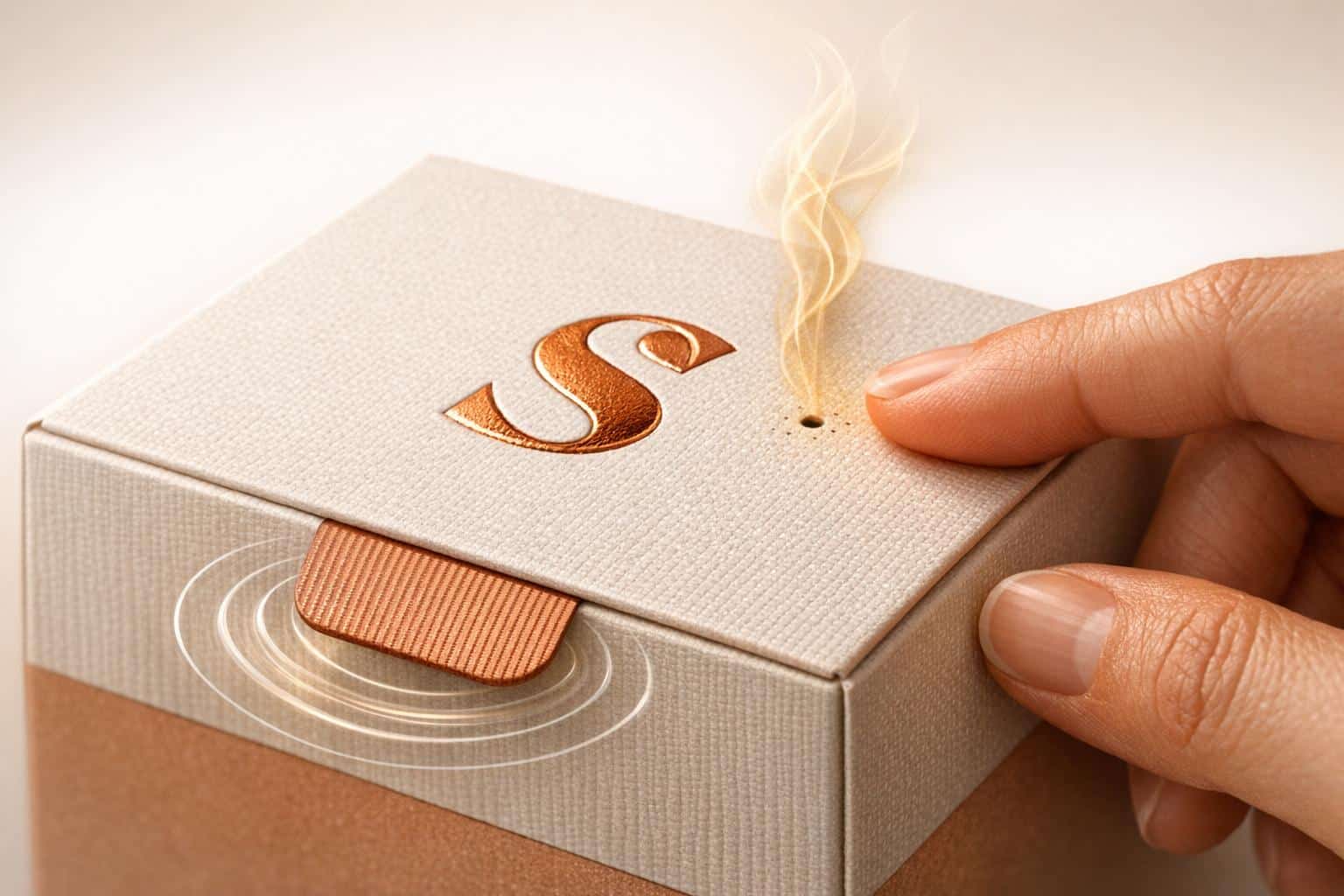
Packaging isn’t just about looks – it’s about creating a full sensory experience. When brands focus only on visuals, they miss the chance to connect emotionally with customers. Sensory packaging – using touch, sound, and scent – can make products memorable and build deeper loyalty.
Here’s why it matters:
- Touch: Textures and materials communicate quality (e.g., soft-touch finishes for luxury or recycled textures for eco-friendliness).
- Sound: Unique auditory cues, like the "snap" of a chocolate bar, enhance recognition.
- Scent: Fragrances trigger emotions and memories, reinforcing brand identity.
Even small tweaks, like adding a textured label or a signature sound, can make a big difference. Brands like Coca-Cola, Magnum, and Tic Tac have mastered this by integrating sensory elements that align with their values. Start small, test ideas, and track metrics like brand recall and repeat purchases to see the impact.
The takeaway: Sensory packaging transforms your product into an experience customers won’t forget.
How the Best Brands Use Sensory Marketing to Boost Sales (with Real Brand Examples)
sbb-itb-aebd855
How Sensory Packaging Strengthens Brand Identity
While visual design grabs attention, it’s the addition of touch, sound, and even smell that creates a fully immersive brand experience [1]. These sensory elements tap directly into the brain’s emotional processing center, making them incredibly powerful. A textured box or a unique sound sticks in memory far better than just a logo. By engaging multiple senses, brands can bridge gaps in connection and leave a lasting impression.
Why Visual-Only Packaging Falls Short
Sure, sight is the first sense shoppers use, but relying on visuals alone limits the depth of engagement [1]. Packaging that focuses solely on appearance creates a flat, one-dimensional experience. And in crowded markets like beauty, food, and wellness, standing out requires more. Without tactile or auditory elements, packaging misses the chance to spark emotional loyalty [1].
Think about it: a heavy box instantly conveys luxury, while rough, recycled textures communicate eco-consciousness [1]. These physical cues bypass logical thinking and go straight to how customers feel about a brand.
The stats are telling. Confidence in connected packaging, which combines physical sensory elements with digital interactions, hit 92.3% by early 2026 [2]. This shows that polished graphics alone won’t cut it anymore. In markets where competitors all have sleek designs, the real winners are those creating multi-layered experiences that stick in the consumer’s mind. This is where multi-sensory strategies come into play, offering deeper emotional connections.
Building Emotional Loyalty Through Multiple Senses
Integrating multiple senses into packaging transforms it from functional to unforgettable. Take Magnum ice cream, for example. Their tubs are designed so customers can squeeze them to "crack" the chocolate shell inside – a tactile and auditory experience that has become a signature part of the brand [1]. Similarly, Tic Tac’s iconic rattle instantly triggers brand recognition [1]. These sensory elements don’t just enhance the experience – they solidify the brand’s identity.
"Stimulating multiple senses creates stronger emotional connections, leading to increased brand loyalty." – Appetite Creative [2]
The trick is ensuring everything aligns with your brand’s message. Kikkoman’s soy sauce bottle, for instance, features an ergonomic design with a dripless spout, reinforcing the brand’s focus on precision and quality [1]. Coca-Cola took it a step further by using thermochromic inks that reveal colorful ice cubes when the can is perfectly chilled – a clever way to turn temperature into a sensory signal of refreshment [1]. Whether it’s kraft paper textures for sustainability or soft-touch finishes for luxury, every sensory detail should reflect your core values [1].
Core Sensory Elements for Packaging Design
These sensory elements help close the gap between a brand’s promise and its physical presence by engaging multiple senses. Together, touch, sound, and scent create a memorable and unified brand experience, each contributing in its own way to how customers perceive and connect with products.
Tactile Features: Texture and Material Choices
The texture of packaging invites interaction, turning a simple glance into a hands-on experience. The moment someone picks up a package, its weight and feel send an immediate message about quality. For instance, thick, textured paper feels sturdy and premium, while lightweight, flimsy materials can give off a less favorable impression [1]. People often make these judgments before even reading the product label.
Finishes also play a big role in shaping perception. A matte or soft-touch finish feels luxurious and comforting, making it ideal for upscale products like boutique skincare [1]. Techniques like embossing or debossing add depth and sophistication, encouraging customers to engage through touch [1]. The key is in the details – every material choice should align with your brand’s core message. And while touch is vital, sound offers another layer to the packaging experience.
Auditory Elements: Sound as a Branding Tool
Sound can act as a subtle yet powerful branding element, signaling qualities like freshness, luxury, or craftsmanship [1][4]. Consider the satisfying "pop" of a seal breaking or the "click" of a magnetic closure – these sounds not only enhance the unboxing experience but also stick in the consumer’s memory. Research even shows that people can identify product interactions based on sound alone with surprising accuracy – 15% better than chance [4].
However, sound must fit the brand’s personality. A misstep can have consequences, as seen in 2010 when Frito-Lay launched a compostable SunChips bag that was so loud it drew widespread complaints, ultimately leading to its removal from shelves [4]. For a luxury skincare line, quiet, smooth-opening mechanisms make sense, while louder, crinkly materials might better suit a snack brand with a bold, energetic image [1]. Testing these auditory cues with focus groups ensures the sounds complement, rather than detract from, the product experience [1]. Beyond sound and touch, scent offers another way to create a lasting emotional connection.
Scent Integration: Using Fragrance to Trigger Emotion
Scent has a unique ability to connect with memory and emotion, making it a powerful tool for brands. Interestingly, about 80% of what we perceive as taste actually comes from smell [5]. By incorporating fragrance into packaging – through scented inks, materials, or inserts – brands can create a fully immersive "brand world" during the unboxing process.
"Scent has a direct connection to memory and emotion, making it a powerful tool for creating lasting impressions." – Scent Journer [5]
The choice of fragrance should align with the brand’s identity. For example, a minimalist brand might opt for subtle, natural scents like wood or herbs, while a swimwear brand could use coconut to evoke a tropical vibe. Mattress brand Woosa takes this approach to the next level with a custom scent of eucalyptus, fresh rain, and patchouli, designed to evoke the feeling of a cozy, rainy night – perfectly in line with its promise of a restful sleep [5]. For beauty brands, incorporating scent into packaging builds trust and reinforces their identity. If resources are limited, focusing on a single standout sensory element, like a signature scent, can be more effective than trying to do it all [5].
Adding Sensory Packaging to Your Brand Strategy
Incorporating sensory packaging into your brand strategy can turn scattered brand elements into a unified, unforgettable experience. Thoughtful planning ensures that every material, texture, and finish reflects your brand’s essence. The aim? To create packaging that feels like a natural extension of your brand’s personality. By doing this, you can close any gaps between your product and its branding.
Matching Sensory Elements with Brand Values
Sensory details should align with both your product’s purpose and your brand’s core values. For instance, a silky label on a scalp oil suggests soothing comfort, while a gritty texture on a protein bar conveys a sense of natural, whole-food integrity [6]. Since people process colors in milliseconds, they’re a powerful tool for creating an emotional connection [3]. Earthy greens and browns evoke natural or plant-based qualities, while blues are often associated with trust and clinical precision [3].
Typography plays a similar role in setting the tone. A sans-serif font might signal modernity and friendliness, while a serif font often suggests tradition and trustworthiness [6]. Adopting a "material-first" approach also matters. By considering the entire lifecycle of your packaging, you can align sensory choices with environmental priorities. In fact, decisions around color, material, and finish (CMF) can account for up to 90% of a product’s environmental impact [6].
Once your sensory elements reflect your brand’s values, the next step is to refine these choices through targeted consumer testing.
Testing and Refining Sensory Concepts
Testing helps ensure your sensory elements connect with your audience before scaling up production. User testing can reveal how consumers interact with your packaging [1]. Focus groups offer detailed insights into aspects like the "click" of a closure or the texture of a material [1], while surveys provide broader feedback on how different sensory elements – textures, sounds, and visuals – are perceived [1].
Start with prototypes, such as textured paper samples or specialty-finished stickers, to refine ideas without committing to costly production [1]. Make sure the unboxing experience reflects your brand identity, whether it’s about freshness, luxury, or something else entirely. For brands working with limited budgets, focusing on a single sensory element with high impact can be a practical first step [1].
Using ChrisRubinCreativ (CRC)’s Brand Foundation Plan

ChrisRubinCreativ (CRC)’s Brand Foundation Plan provides a structured way to integrate sensory elements into your brand strategy. This plan includes a Sensory Brand Guide, which complements traditional visual guidelines. It outlines specific color palettes, sound profiles, scent descriptions, and texture standards [7], helping brands identify and prioritize the sensory touchpoints that matter most to their customer experience [7].
The plan emphasizes aligning sensory cues with brand values. For example, rough, recycled textures might suit a sustainability-focused brand, while smooth, heavy materials could work for a luxury product [8]. CRC recommends starting small – focusing on one or two senses, such as sight and touch – before expanding to more complex elements like scent or sound [7]. Testing methods like A/B testing and focus groups can help fine-tune these elements by gauging subconscious consumer reactions before full-scale production [7].
Brands that consistently deliver sensory experiences can boost their impact by up to 30% [7], and engaging three or more senses simultaneously can amplify that effect to as much as 70% [8]. These strategies ensure that every sensory choice strengthens your brand’s overall identity and leaves a lasting impression.
Measuring the Impact of Sensory Packaging
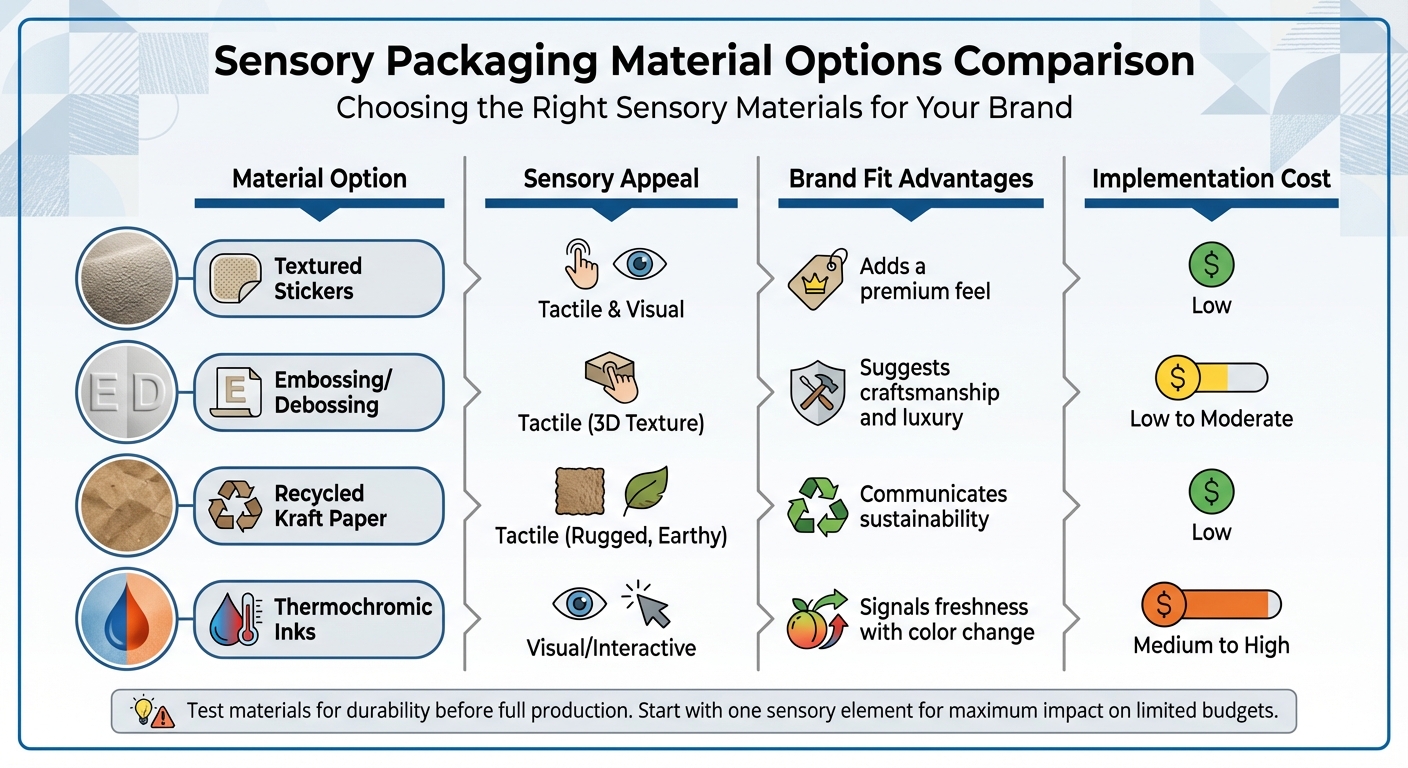
Sensory Packaging Material Options: Appeal, Brand Fit, and Cost Comparison
Once you’ve refined your sensory packaging strategy, it’s essential to track its performance. Clear metrics help determine whether your efforts are boosting brand recognition and fostering customer loyalty. By measuring the right data points, you can confirm that each sensory element is effectively reinforcing your brand’s message.
Metrics for Tracking Sensory Impact
To evaluate the effectiveness of sensory packaging, focus on three key areas: brand recall, repeat purchases, and emotional engagement. These can be assessed using surveys, focus groups, and digital tracking tools [1][2].
- Brand recall rates: This metric indicates how well your customers remember your brand after interacting with your packaging. For instance, if customers can identify your product just by its texture, sound, or scent, you’ve successfully created a memorable sensory signature. Post-purchase surveys can highlight which aspects of the unboxing experience stood out most to your audience.
- Repeat purchase behavior: Tracking repeat purchases helps measure customer loyalty. Compare repurchase rates before and after introducing sensory elements to understand their impact.
- Emotional engagement: Use focus groups to explore how your packaging’s textures, sounds, or scents resonate emotionally with customers. For more precise data, digital tracking tools like QR codes or NFC technology can monitor how consumers interact with your packaging in real time. Research shows that connected packaging analytics achieved a 92.3% confidence rate by 2026, making these tools increasingly reliable [2].
Additionally, observing how customers physically interact with your packaging during unboxing can reveal which sensory cues leave the strongest impression. For brands with tighter budgets, it’s wise to focus on the sensory element that generates the most significant response [1].
Comparing Sensory Material Options
Beyond emotional and behavioral metrics, it’s important to evaluate the materials used in your packaging. The right materials can enhance the tactile, visual, and even auditory appeal of your packaging while staying aligned with your brand identity and budget.
| Material Option | Sensory Appeal | Brand Fit Advantages | Implementation Cost |
|---|---|---|---|
| Textured Stickers | Tactile & Visual | Adds a premium feel | Low |
| Embossing/Debossing | Tactile (3D Texture) | Suggests craftsmanship and luxury | Low to Moderate |
| Recycled Kraft Paper | Tactile (Rugged, Earthy) | Communicates sustainability | Low |
| Thermochromic Inks | Visual/Interactive | Signals freshness with color change | Medium to High |
- Textured stickers are an affordable way to introduce a premium feel to standard packaging [1].
- Embossing and debossing add a sophisticated, tactile element that conveys craftsmanship with a moderate investment [1].
- For eco-conscious brands, recycled kraft paper offers an earthy texture and emphasizes sustainability without breaking the bank [1][3].
- Thermochromic inks provide an interactive visual element by changing color based on temperature, though they come with higher costs [1][2].
Before committing to full production, test your chosen materials for durability to ensure they can withstand shipping and handling [3]. A/B testing with e-commerce mockups can also help you gauge engagement metrics like click-through rates. For deeper insights, consider conducting in-home use tests to capture emotional reactions to various textures and designs [3].
Wrapping It Up
Sensory packaging plays a powerful role in bridging gaps within a brand by transforming its identity into an emotional experience. When you incorporate multiple senses – like touch, sound, and scent – alongside visuals, you create a deeper connection with your audience. This approach embeds your brand into customers’ emotions, fostering trust and loyalty through memorable interactions. In fact, consistent sensory experiences can enhance a brand’s impact by up to 30% [7]. As Nimisha Modi from Confetti puts it, "By thoughtfully considering sight, touch, sound, smell, and taste, brands can craft an identity that is not just seen but felt" [1]. These emotional connections are what keep customers coming back time and time again.
If you’re just starting, focus on one sensory element – perhaps a unique texture, a signature sound, or even a subtle scent. Ensure it aligns with your brand values and measure its effect on customer recall and loyalty.
Looking to take your brand identity to the next level? ChrisRubinCreativ (CRC) can help. Their Brand Foundation Plan is designed to develop a cohesive brand identity and messaging strategy that integrates sensory design principles. With expertise in storytelling and brand strategy, CRC helps businesses go beyond just visuals to craft rich, multi-sensory brand experiences that resonate and drive growth.
FAQs
Which sensory element should I add first – touch, sound, or scent?
Touch plays a crucial role in sensory packaging. The feel of tactile textures and materials creates a physical connection that taps into memory and emotions. This interaction leaves a strong, lasting impression, making it a powerful first step in engaging the senses.
How can I test sensory packaging ideas without a big budget?
Testing sensory packaging ideas doesn’t have to break the bank. You can keep costs low by organizing small focus groups, conducting informal surveys, or creating simple prototypes to gather feedback. Techniques like rapid profiling or discrimination testing are also great for assessing elements like textures, colors, and materials. These methods help you fine-tune your packaging concepts and make smarter decisions – all while sticking to your budget.
What KPIs show sensory packaging improves loyalty?
When it comes to measuring how sensory packaging impacts customer loyalty, several key performance indicators (KPIs) stand out. These include customer satisfaction, brand attachment, and sensory brand experience metrics.
These metrics are directly influenced by the sensory elements of the packaging – what customers see, hear, smell, touch, and taste. For instance, a visually appealing design or a satisfying tactile experience can leave a lasting impression.
To evaluate these KPIs, businesses can rely on tools like customer feedback surveys and engagement data. These insights help connect sensory packaging efforts to measurable outcomes, offering a clear picture of how these elements shape customer loyalty.